Showing posts with label Cloud Strife. Show all posts

Sunday, January 8, 2023

Final Fantasy VII Remake.


Original Release: Playstation 4, 2020. Version Reviewed: Playstation 5 "Intergrade" Version, 2021.


THE PLOT:

The Shinra Electric Power Company has revolutionized the modern world by mining Mako, an extremely efficient energy source. It allows them to provide power and comfort for the masses, making themselves extraordinarily rich and powerful in the process.

Environmental group AVALANCHE believes that Shinra's reliance on Mako is destroying the planet. Former Shinra military SOLDIER-turned-mercenary Cloud Strife accepts a job from them: an act of eco-terrorism, blowing up one of the reactors fueling the city of Midgar.

The detonation does untold damage within the city, but this isn't the work of AVALANCHE: Shinra's leaders magnified the explosion, attempting to use the attack to justify a new war with old enemy Wutai. Cloud, his childhood friend Tifa, and AVALANCHE leader Barret find unexpected aid in the form of flower girl Aerith, whose seemingly mundane life covers a mysterious past.

But Shinra isn't done. Cloud and his friends learn that the company plans to stage an even more devastating attack in the slums they call home. They race to try to prevent disaster - but another force seems determined to keep them from changing anything...

Cloud, Tifa, and Barret are ready for action.

CHARACTERS:

Cloud: I was dubious when I first read that the remake had recast all roles. It took all of ten minutes for the game to convert me. The new cast is excellent all around, with actor Cody Christian helping to make Cloud actually likable for the first time ever. Between Christian, the excellent character animations, and the script, we get a sense of the human being beneath Cloud's reserve. I particularly enjoyed Cloud's reactions to flirting, teasing, or displays of affection - He's outright baffled by both Aerith and Jessie, and yet it's clear that he becomes quickly attached to both of them.

Tifa: Cloud's childhood friend. When Cloud left to join Shinra with the goal of becoming a SOLDIER, she made him promise to rescue her if she ever needed it. Years later, Tifa (Britt Baron) feels trapped by AVALANCHE's escalating tactics, and yet it's no longer in her nature to ask for help. She's become a caregiver, watching over Barret, his daughter Marlene, and the Seventh Heaven bar - essentially acting as a mother figure to all despite still being quite young herself. She even helps Cloud build his reputation as a mercenary by finding jobs for him in the slums early on - a way of padding the game, but one that works in terms of building the characters and their world.

Aerith: The flower girl with the mysterious past. Actress Briana White's vocal deliveries provide just the right mix of chirpy innocence with flirtatious teasing for the character, making it easy to believe how quickly she both enchants and confounds Cloud. A refreshing carryover from the original game is that, while both she and Tifa are presented as potential love interests, there's no sense of rivalry between them; when Aerith and Tifa finally meet, they seem to instantly connect as friends even as they take turns vying for Cloud's attention.

Barret: The single most improved character. I (eventually) liked Barret in the original, but he was never high on my list of favorites. Remake transforms him into the cast standout, with voice actor John Eric Bentley alternating between very funny comedy lines to moments of shockingly raw emotion. There's a scene that sees Barret literally beating his one good hand against rubble, as if trying to move it by force of will, that is more memorable than many scenes from very good movies.

AVALANCHE: The trio of Jessie, Biggs, and Wedge are elevated from little more than extras to full supporting characters. Jessie (Erica Lindbeck) has a playful surface, but a visit to her family shows some of the layers beneath that; cautious and professional Biggs (Gideon Emery) left a job teaching children in order to join AVALANCHE; Wedge (Matt Jones) is cheerful, but his constant smile covers insecurities that he doesn't do as much as his colleagues, with him at one point deriding himself as useless. All three register strongly, which helps to make certain events in the story a lot more effective.

Sephiroth: The portion of the original Final Fantasy VII that this game covers did not even feature Sephiroth: He was named, and eventually we saw the aftermath of his presence, but we didn't actually meet him in person until much later. But he's the "fan favorite," so this was not an option for the remake... unfortunately. By holding him back, the original turned him into a larger-than-life figure long before we met him. Here, Cloud sees flashes and visions of him starting very early in the game - which has the effect of diminishing him, so that when he's finally encountered in person at the end, there's no sense of anything special about the encounter. I will say that the boss battle against him here is much more satisfying than the one in the original Final Fantasy VII (OG Sephiroth is not a hard boss fight) - but as a character, overuse has made him a lot less interesting. In fairness, this was already true from earlier spinoffs, but his treatment here doesn't reverse the trend.

Combat is energetic and intuitive most of the time,
but it can become hectic and frustrating...

COMBAT:

Unlike its namesake, Final Fantasy VII remake uses real-time combat. The ATB bar is still critical - but now it doesn't control your ability to do normal attacks, but rather your ability to use magic and special attacks.

Most of the time, the combat is energetic and intuitive. Against tough bosses or mobs of enemies with resistances to normal attacks, however, this ATB/real time hybrid becomes too frenetic for my personal tastes. Too often in the final stages of the story, combat becomes endless dodging while waiting for the ATB bar to fill - which then usually has to be used up with healing, because the AI teammates are (as usual) morons with no sense of self preservation.

Then there are the "gimmick" battles that are basically impossible until you figure out the right approach - at which point they instantly become a cakewalk. Yes, Rufus Shinra, I'm looking at you.


QUESTS AND EXPLORATION:

The combat may be a mix of fun and frustrating, but the exploration of environments is a consistent joy. Final Fantasy VII Remake recreates many of the environments of the PS1 original faithfully, but with new detail and scale.

This is a beautiful-looking game, from the organic beauty of Aerith's garden to the cold sterility of the Shinra building. The residential slums are vibrant and alive, with extras (many of them with recycled character models) everywhere. You pick up snatches of conversations as you run past, and these bits of chatter help to create the impression of a fully realized world. At many points, I found myself just stopping what I was doing to listen to side conversations, take in the soundtrack, and rotate the camera and gasp at the game world.

There are three main areas in which you pick up side quests. Tifa helps Cloud get mercenary jobs in the Sector 7 slums; later, Aerith does the same in the slums that are her home. Finally, Cloud (and later Tifa) will engage in fetch quests in the overcrowded, overlit Wall Market. Most of these quests are standard fare - though some of the Wall Market ones get suitably wacky - but it's fun to see people's evolving reactions to Cloud as he completes them, and they provide a good opportunity for practicing combat mechanics, learning how the maps work, and just building the sense of the overall world.

Aerith's garden: detailed and beautiful.

A PARTIAL TRIUMPH...:

Final Fantasy VII Remake gets so much exactly right. It feels modern and immersive, while at the same time showing respect to the 1997 original. The characters have depth, and the voice acting ranges from very good to outstanding.

Then there's the music score. Final Fantasy VII's score was already outstanding back in 1997. Hearing those same tracks brought to life with a full orchestra is a tremendous experience, and the handful of new tracks blend well with the remixes of old ones.

The story covers only the first 5 - 6 hours of the original game, so a lot of material is extrapolated. This isn't inherently a problem. The place chosen as the break point makes sense, and the city and its areas are varied enough to be worth exploring. Cloud taking on mercenary jobs is fun as a diversion, while at the same time allowing the game to chisel some much-needed cracks early on into his moody surface. A trip to the more affluent topside area, with Cloud tagging along for a visit to Jessie's family, is an entirely new sequence that opens up the world while adding further depth both to Cloud and to the supporting cast.

Finally, the Wall Market sequence is beautifully executed. This break in the action comes at the exact right point in the story. The first Act has ended, and the stakes have temporarily lowered - meaning that there's nothing interfering with enjoying Cloud engaging in squat battles and running increasingly bizarre errands for the market's outlandish denizens.

In the original game, this sequence was fairly short and culminated in a somewhat strained cross-dressing gag that seemed unlikely to translate well to 2020. I think a lot of people expected the remake to cut that out entirely. Instead, the game creators lean into it. Cloud's cross-dressing still happens... but now it comes at the end of a dynamic cabaret sequence, complete with a rhythm mini game, as the ultra-fabulous Andrea remakes Cloud while urging him to embrace the moment. It's not only more positive and meaningful than the same bit in the original game... it's a lot funnier!

Oh, and the Yuffie DLC included in the Intergrade edition is delightful from start to finish, turning comedy relief character Yuffie into a likable but fully realized individual, while still keeping her exasperating original personality intact. If I were to rate it separately, I'd probably give the DLC a higher individual score than the main game. It's long enough to be a substantial expansion, but not so long that it overstays its welcome - which unfortunately isn't something I can say for much of the main game...

Aerith communicates with a spirit, in one
of many sections that goes on way too long.

...IT'S JUST TOO OVERSTRETCHED:

The biggest problem with Final Fantasy VII Remake is that, in trying to pad 5 - 6 hours of material to fill a complete AAA title, the story is left feeling more than a little stretched out.

This becomes apparent early on. After the destruction of the first Mako reactor, Cloud flees through the streets of Midgar. In the original game, this takes up just a few minutes. This has been opened up, so that players now control Cloud as he flees through streets, up rooftops, down fire escapes, and into alleyways. At first, this is a good change, letting players experience Cloud's escape while exploring these incredibly detailed environments. The problem? The whole sequence goes on for what feels like an hour. The action becomes repetitive, and the story is mostly put on hold.

The pacing improves again after that... Until the second reactor mission. Instead of going straight to the mission, players now have to go through a network of tunnels, battling Shinra robots and giant monsters. Just as this starts to get old, Cloud, Tifa, and Barret reach "Sector G" for an entirely new chapter, in which they must divert energy from giant lamps to traverse the sector.

Meaning that after one overlong section of going through tunnels, players are instantly given another long section of going across bridges and up and down staircases. There are a few fun moments (if you divert to collect some shiny materia, Barret will sing-song that the group is "going on an adventure to find some treasure!"), but the entire segment feels like it was pasted in just to extend the runtime.

The worst offender comes in the final third, when the team infiltrates the Shinra building. Like most of the game, this is initially engaging. The corporate setting is enjoyably different from the slum, city, and warehouse environments of the rest of the game, while at the same time feeling like what it is: the center of the society we've observed up to now. Everything up to and including Aerith's rescue is fun to play, with a nice mixture of story beats, character bits, and varied gameplay.

But after Aerith's rescue, instead of going straight to the final confrontations with the Shinra President and Sephiroth, the game has to stretch itself out one more time. Gamers get to suffer through an extended sidetrip through the laboratory of the mad Professor Hojo. This section offers nothing new in gameplay terms - switch puzzles, enemy encounters, a boss fight - and in story terms it's an irrelevance.

As with other diversions and attenuations, once gamers get past it, the very last section is back to being enjoyable, with the Shinra President faceoff even managing a few surprises. But it's an ongoing issue that the game keeps stalling its own momentum, forcing the story to effectively jumpstart itself multiple times throughout, all in order to be that little bit longer.

Aerith has a secret. A few secrets, actually.

OVERALL:

Final Fantasy VII Remake is a good game by any reasonable standard. It's gorgeous to look at, with cutscenes and gameplay blending often indistinguishably. The story cutscenes are well-written, boasting dialogue that reveals character and builds the game world while entertaining at the same time. Voice acting is top-notch, and the music is magnificent.

It's just a shame that it's so badly padded. I think about games like I think about movies: They should be as long as they need to be and no longer. Unfortunately, modern AAA games are now expected to be lengthy, too often to their detriment, and that is very much the case here.

Had Final Fantasy VII Remake been 20 - 25 hours in length (maybe 30 for completionists), I'm pretty sure I would be raving over it. But add in an additional 10 hours, and it's left feeling sluggish. Too many of the major story beats are held too long, and the pacing regularly stops and starts for the sake of lengthy patches in which the characters do nothing but travel from Point A to Point B.

In the end, I'd say the good outweighs the bad, and I am looking forward to the next installment, Rebirth. Since it will pick up at the point the game world opens up, I'm hoping (against hope?) that it can provide a full experience without the stop-and-start pacing that marred this title.


Overall Rating: 7/10.

Prequel: Crisis Core - Final Fantasy VII
Sequel: Final Fantasy VII - Rebirth (not yet reviewed)

Previous Main Series Game: Final Fantasy VI
Next Main Series Game: Final Fantasy VIII

Previous Release: Dissidia Final Fantasy NT (not yet reviewed)
Next Release: Stranger of Paradise - Final Fantasy Origins (not yet reviewed)

Review Index

To receive new review updates, follow me:

On BlueSky:

On Threads:

Friday, July 29, 2022

Crisis Core: Final Fantasy VII

Original Release: Playstation Portable, 2007. Version Reviewed: Playstation Portable, 2008.


THE PLOT:

SOLDIER Second Class Zack Fair dreams of being a hero. Working for the Shinra Power Company under the supervision of his mentor, the meticulously honorable Angeal, Zack's goal is simply to help. It's never occurred to him that he might be fighting on the wrong side. After all, Shinra brings cheap, efficient power to the world. How could that possibly be bad?

Angeal disappears following a strike on Wutai, a village that has resisted Shinra. When the company declares Angeal a rogue agent, Zack can't believe it... until he finds his mentor amidst the ruins of his home village. Zack learns that Angeal and Genesis were both part of the top-secret "Project G." Their DNA was altered during experimentation. Genesis is now degrading, and he will do anything to stop that degradation - even if it means going to war with Shinra!

Zack is assigned to kill both ex-operatives, working under the supervision of the heroic SOLDIER First Class, Sephiroth. Despite their orders, Sephiroth prefers to find a way to bring his old friends in alive.

But as their mission moves from Midgard, to the abandoned reactor at Modeoheim, to the rural village of Nibelheim, it gradually becomes clear that Angeal and Genesis were not the only ones Shinra experimented on - and that Zack might soon be facing these powerful adversaries alone!

Zack Fair: He just wants to be a hero...

CHARACTERS:

Zack Fair: Zack had a minor but critical supporting role in Final Fantasy VII. He's promoted to lead here, and fortunately his characterization is the game's single best feature. Zack is basically the anti-Cloud. He's friendly, bordering on boisterous, and is almost instantly likeable. He becomes disillusioned with both SOLDIER and Shinra as the story goes on. Still, he doesn't allow himself to become bitter, focusing on doing something good even as it becomes clear that his employers no longer share those values (if they ever did).

Genesis: If Zack is the best-realized character in the game, then Genesis is the worst. I know I still have quite a few titles to get through; but in a single game, Genesis puts himself in the running for Worst Character in the Franchise. He's meant to be a tragic figure, except... Well, he's so utterly insufferable! Most of his dialogue consists of bad poetry, with him obsessively grafting his own life onto the text of the epic, Loveless. His actions are motivated by his desire to save himself from his degradation - but "save my own skin" stops being sympathetic when you engage in wholesale slaughter to do it. Oh, and that degradation? A flashback reveals that it's the result of his own ego, when jealousy led him to challenge Sephiroth to a not-so-friendly duel.

Sephiroth: Portrayed as basically pretty decent, at least at the start. Despite the order to hunt down and kill his close friends, he is determined to bring them in alive if possible. He works well with Zack, prodding the junior agent to do his best work, and is also friendlier than he has to be to a certain young Shinra security man. This would make his inevitable descent much more effective... If that descent was actually expanded on, rather than happening just as quickly as it did in the flashback in the original Final Fantasy VII. As backstory in that game, it worked well enough to impart the needed information; as current story in this game, it feels rushed and thinly motivated, with the only real addition being a quick poetry recital by Genesis.

Real-time combat is fluid and fun - when not disrupted by gimmicks.

GAMEPLAY:

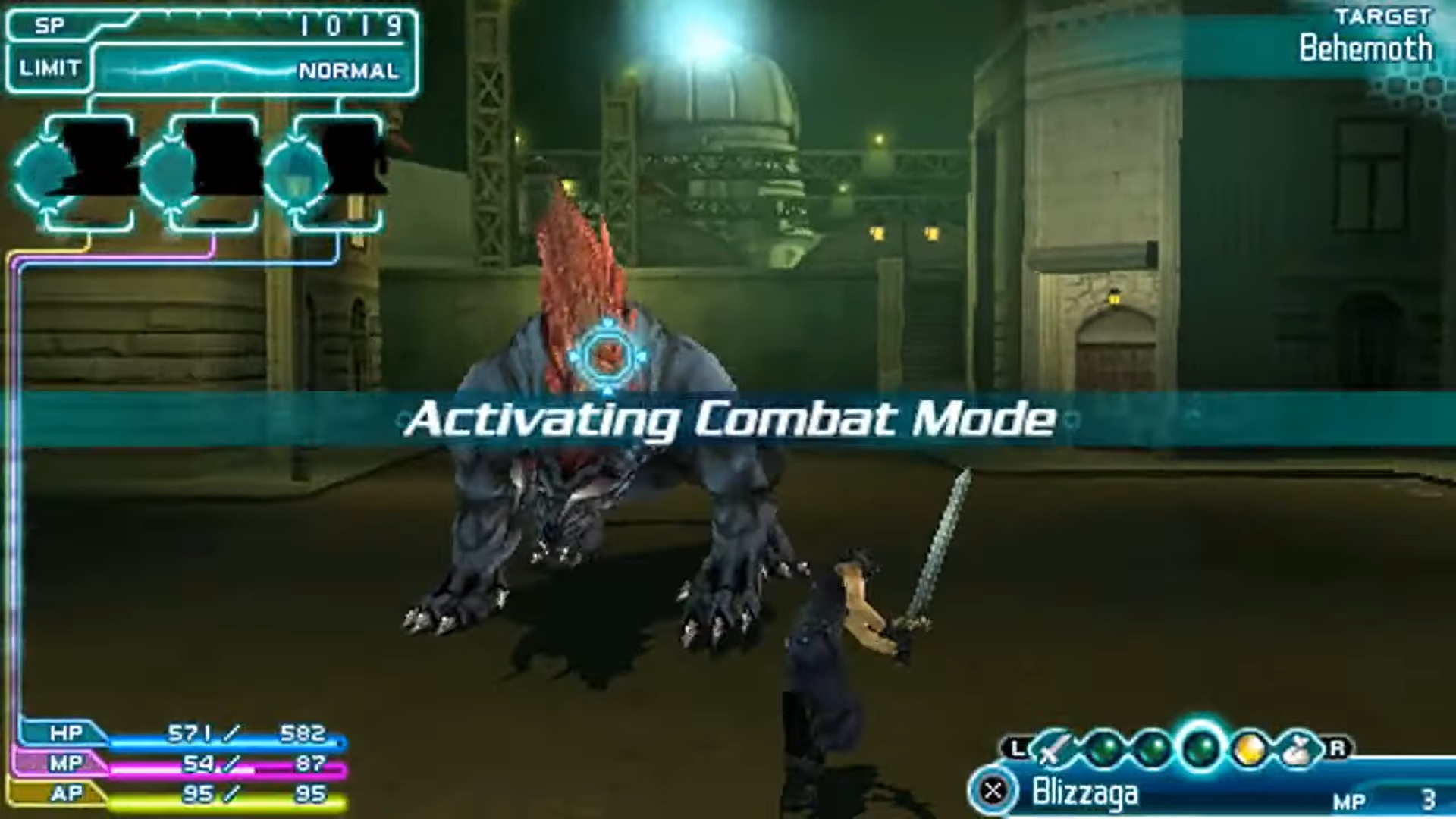
"Activating combat mode."

Crisis Core replaces the series' usual semi-turn based, ATB-gauge driven encounters with real-time combat. This is largely fluid and well-implemented. The triangle button blocks; the X button hits; the shoulder buttons are used to switch from swords to spells to items. Using items in combat can feel hectic and cumbersome, simply because you have to shoulder button through two menus to find and use the correct item, but it's overall engaging and surprisingly intuitive. Except that...

"Modulating Phase." (roulette wheel spins)

Except that, on top of the real time combat, Square Enix added the "Digital Mind Wave" (DMW). This is a roulette-like phase that, depending on its results, can result in special attacks and level ups both for skills and for Zack in general. It is the only way to gain levels in this game, so it is essential. It is also incredibly aggravating in its execution, particularly because...

"Modulating Phase." ---> 'Lucky Stars' "You can do it, Zack!" "Yeah, I'm on fire now!"

Particularly because the player is given no control over its activation. You'll find Zack powering up healing abilities while at full health, or using Summons that you'd prefer to save for a boss battle on no-challenge, low-level grunts. Not to mention...

"Modulating Phase." ---> No Match."

Not to mention that the DMW constantly interrupts the flow of combat... Meaning that if you don't get a match and nothing happens, the fraction of a second it takes for you to go back to dodging an enemy or casting a healing spell could all too easily result in a "Game Over." Crisis Core's main story is overall quite easy; as such, I'm pretty sure I died to DMW interrupts more often than anything else.

Finally...

"Modulating Phase."

Finally, I became extremely tired of the computerized voice intoning these phrases. Really, very, extremely tired.

"Conflict Resolved."

Fallen angels: Angeal, Sephiroth, and Genesis.

THOUGHTS:

Crisis Core, developed for Sony's Playstation Portable, stands as a showcase for the handheld's capabilities... as well as its limitations. The game offers dynamic (if flawed) combat, a terrific soundtrack, a variety of reasonably detailed environments, and cutscenes that are both fully voiced and skillfully animated.

The trade-off for all this is that the environments themselves are small. Very small. Most environments, whether interior or exterior, whether made for exploration or dungeon crawling, are similarly structured: A main path that loops around to maximize the limited space, with a few side paths leading off from it. In the city of Midgar, there will be three or four people per map whom you can talk to, and then you reach the border and a new, adjacent environment loads. In a dungeon, you fight three to four random encounters before reaching the border of the map and loading a new environment.

At least the story is good... for a while. The narrative spans years as it moves from the end of the war with Wutai to the hunt for Genesis. Through Zack's eyes, we get a sense of Shinra's degradation across this time that parallels Genesis's own degradation. Professionals who seem both affable and committed to their work are replaced by people who seem sinister or even disturbed. Scientific projects are shelved in favor of sinister experiments. By the time the fateful Nibelheim mission occurs, Zack wonders aloud what point there is to any of this, a statement of weariness that's a sharp counter to his early enthusiasm.

There's also a nifty thread involving the iconic Buster Sword, which emerges as a legacy in its own right. At the start of the game, the sword belongs to Angeal, Zack's mentor. As the story progresses, Angeal passes the sword to Zack. At the same time, Zack meets Cloud and becomes, in effect, his mentor... and of course, we already know that the game will end with Zack passing the sword onto Cloud - passing the torch between prequel and main game. Save for an overinflated speech at the end, this is all generally well done.

It's just a shame about the third Act.

The poetry-spewing Genesis: Worst Final Fantasy villain?

As the action moves to Nibelheim, everything seems in place for a memorable closing. Genesis has been defeated; Shinra has degraded into an entity Zack either can't or doesn't want to recognize; and he's embarking with Sephiroth on the misson that was the key backstory to Final Fantasy VII. At this point, all the game has to do to end up a firm winner is just flesh out the Final Fantasy VII flashback into a detailed chain of events.

But it's here that it all goes wrong. After spending a bit of time in the Nibelheim outskirts fighting enemies and completing side quests, you reach those key events... And then skip right over them, seeing basically only what was previously portrayed in flashback. Except with Genesis returning for no good reason except to make sure that Sephiroth is no longer even the focus of his own breakdown.

This is followed by an entirely unnecessary Fourth Act in which Zack (once again) tracks down Genesis, to a final dungeon that turns into an extended Easter Egg hunt. No, really: To proceed, you need to find all of the chests holding stones needed to unlock a door, while pausing to read synopses of the Acts of Loveless from headstones. When you finally reach Genesis, he first spouts more Bad Poetry at us... and then reveals that his sub-Vogon Poetry is also his deadliest attack.  The final fight is the series' most ludicrously easy Final Boss Battle since Mystic Quest, basically just requiring whaling on him and healing up whenever Zack's health gets low.

It ends with a brief epilogue leading directly into Final Fantasy VII. By this point, however, my previous engagement with the story was gone. I simply couldn't make myself care as the last cutscene played out. There's a post-credits bit meant to recreate the opening of the main game in the context of what we've just played... but even this doesn't work, with Cloud's attitude in this scene a complete mismatch with his ambivalence at the start of Final Fantasy VII.

Feathers from a fallen angel.

OVERALL:

There is much to recommend in Crisis Core. Despite technical limitations resulting in small and repetitive maps, the first half is genuinely very good. Zack is a likeable hero, and the background portrayal of Shinra's decline creates an effective parallel with the main plot.

I would rate this game much higher had the final Act not so thoroughly shredded the goodwill built up early on.  I'd still consider it worth tracking down, at least if you own a PSP. Though it was never made available digitally, as of this writing physical copies remain very affordable. It isn't a terribly long game (less than 30 hours, unless you try to play all the "Missions"), and there's enough that's good to offset the bad.

But with the final Act turning into a tedious and misjudged slog, I ended up with a negative final impression - even though, if pressed, I enjoyed more of it than I didn't.


Overall Rating: 5/10.

Alternate Version: Last Order - Final Fantasy VII (anime)

Followed by: Final Fantasy VII
Followed by: Final Fantasy VII Remake

Previous Main Series Game: Final Fantasy XII (not yet reviewed)
Next Main Series Game: Final Fantasy XIII (not yet reviewed)

Previous Release: Final Fantasy Crystal Chronicles - Ring of Fates (not yet reviewed)
Next Release: Final Fantasy Tactics A2: Grimoire of the Rift (not yet reviewed)

Review Index

To receive new review updates, follow me:

On BlueSky:

On Threads:

Friday, April 29, 2022

Last Order: Final Fantasy VII.

Sephiroth turns against his former allies.

Release Date: Sept. 14, 2005. Approx. 25 minues. Written by: Kazuhiko Inukai. Directed by: Morio Asaka. Produced by: Masao Maruyama, Jungo Murata, Akio ÅŒfuji.


THE PLOT:

SOLDIER First Class Zack Fair (Kenichi Suzumura) is fleeing with his friend, Cloud Strife (Takahiro Sakurai), who has been left insensible by exposure to the energy source Mako. They are pursued by operatives of Shinra, the power company that effectively acts as the government for Midgar.

Five years earlier, both Zack and Cloud were part of an expedition to the small town of Nibelheim. It was just a routine investigation into a malfunctioning Mako reactor - until their superior, the legendary SOLDIER operative Sephiroth (Toshiyuki Morikawa) made a discovery that drove him murderously insane.

It was up to Zack to stop Sephiroth. But no one could have predicted the consequences of their confrontation within the reactor...

Zack tries to save the drug-addled Cloud from Shinra.

CHARACTERS:

Last Order runs a brisk, tightly focused 25 minutes. As such, we only observe the characters in two situations: Zack and Cloud fleeing from Shinra in the present; and Zack, Cloud, Sephiroth, and local guide Tifa (Ayumi Ito) five years in the past. Characterizations are entirely consistent with Final Fantasy VII and its related media: Zack is as decent as he is skilled; Cloud (when conscious at least) is capable of remarkable determination; Tifa memorably cries out her rejection of all things related to Shinra and SOLDIER.

Given that the flashback only depicts the confrontation at the reactor, we see only the Sephiroth who has already gone insane. Zack and Cloud both talk about how they previously admired him... but we see only the monster that he has become, with no real sense of the man he was before. It works well if you've already played Final Fantasy VII and know the general backstory - but I doubt it would have much impact if viewed completely in isolation.

Tifa and other survivors in the burning wreckage of their village.

THOUGHTS:

Last Order: Final Fantasy VII was not made for people not already familiar with Final Fantasy VII. The frame story feature Zack's flight with an unresponsive Cloud, while the bulk of the action fleshes out the main backstory from the original game: the battle with Sephiroth in the Nibelheim reactor.

This OVA (original video animation) was released by Madhouse Animation Productions as part of the collector's edition of the feature-length Final Fantasy VII: Advent Children. Though largely well-received, it still earned some backlash from fans who were upset about slight changes to the events seen in the Final Fantasy VII flashback. When prequel game Crisis Core was released two years later, these changes were wound back... though I'd argue that in their place were more egregious retcons (*cough* Genesis *cough*) that did far more to undermine the significance of events than any of the tiny variances found here.

I far prefer this movie's version of the Nibelehim fight and Zack and Cloud's flight from Shinra to the portrayal in Crisis Core. There's a stronger sense of immediacy and impact here, from Tifa's anguished rejection of Shinra to the duel that is the film's centerpiece. In Crisis Core, events felt rushed and were thrown further off-balance by the inclusion of new villain Genesis. In this OVA, the action is more focused and its significance is felt. At least, it is if you already know who the characters are and why they're fighting; no allowances are made at all for those new to the Final Fantasy VII universe.

The hand-drawn artwork is gorgeous, while at the same time remaining mostly visually consistent with the original game. There are animation cheats - In many places, editing tricks are employed to disguise the use of still frames, and a few of the cuts are genuinely distracting. Still, the entire production is more polished than it really had to be, and it's clear that a lot of time, love, and effort went into this film.

The Nibelheim Massacre: The event that changed everything...

OVERALL:

The biggest criticism I could levy against Last Order is that it feels like half a movie. We jump into the main action with Sephiroth already on the rampage and Nibelheim already destroyed, and the narrative makes no allowances for viewers not already familiar with these events. Had it been ten minutes longer, opening with the investigation of the reactor and the discovery that drove Sephiroth mad, it would feel much more complete, and might actually be accessible to the uninitiated.

Still, the film clearly wasn't made for them. This was made squarely for fans who need no introduction to the characters or their world. For that audience, Last Order is dramatically satisfying and well worth the 25 minutes that it takes to view it.


Overall Rating: 7/10.

Alternate Version: Crisis Core - Final Fantasy VII

Followed by: Final Fantasy VII
Followed by: Final Fantasy VII Remake

Review Index

To receive new review updates, follow me:

On BlueSky:

On Threads:

Final Fantasy VII: Advent Children.

Cloud Strife returns to action - but he's not quite the man he was...

Release Date: Sept. 14, 2005. Running Time: 101 minutes (theatrical version), 126 minutes ("Complete Edition"). Written by: Kazushige Nojima. Directed by: Tetsuya Nomura. Produced by: Yoshinori Kitase, Shinji Hashimoto, Ichiro Hazama.


THE PLOT:

It has been two years since Cloud Strife and his friends defeated Sephiroth and saved the world. The once-powerful Shinra Corporation is now reviled, and Shinra is also being blamed for the rise of a new disease: Geostigma, a mysterious illness that afflicts people apparently at random and has no cure. Cloud and Tifa have taken in Denzel, an orphan afflicted with the stigma, and Cloud has been searching for a cure... but has also come down with the disease himself!

Cloud is summoned to a meeting with Rufus Shinra, the former president of the corporation. Rufus informs Cloud that a new threat is rising: Kadaj, Loz, and Yazoo, three Sephiroth remnants who will stop at nothing to be reunited with their "Mother" - the alien Jenova, whose cells gave birth to Sephiroth and the other remnants.

Cloud wants no part of a new battle. Kadaj, however, wants to face the man he sees as his "brother," and forces the issue - attacking Tifa and kidnapping Marlene, her adopted daughter. Denzel is also lured by the group along with Midgar's other afflicted children. Now Cloud needs to fight - but he may not be in any physical or mental state to survive the battle!

Kadaj and his remnants: Desperate to find their "mother."

CHARACTERS:

Cloud Strife: As the film opens, Cloud has cut himself off from his makeshift family. He now splits his time between wandering the countryside (presumably still searching for a cure) and staying alone at Aerith's church, wracked with guilt over letting her die. He comes back to himself after Tifa and Marlene are threatened by Kadaj's gang and Denzel is brainwashed by them, rediscovering the importance of his connections with others. And if that sounds familiar... Well, yes, it is pretty much the exact same character arc he went through in the original game, only with a deadly disease added into the mix. I suppose the writers figured that a recycled character arc was better than no character arc at all.

Tifa Lockhart: She was a main character in the game but has been reduced here to a two-dimensional cipher. She's not a person in her own right; she's just Cloud's Anchor to Humanity (TM - and insert eyeroll). Not helping matters is her repetition of a bizarre, childlike refrain: "dilly-dally shilly-shally," which she uses in response to Cloud's broody moments. I know it's meant to be her puncturing his self-importance, but it plays poorly, as unfortunately do most of Tifa's scenes, which are not helped by sub-George Lucas dialogue.

Denzel: We meet him at a low point, depressed over the loss of his family and the life he knew, and also blaming himself for Cloud leaving. When Kadaj's group dangles the hope of a cure, he's primed to take it. He seems to sense something is off as he and the other children are taken far from the city, but he's not inclined to care what happens, telling a fellow passenger that it doesn't matter anymore.

Zack/Aerith: Cloud's fallen friends receive a decent amount of focus, with Cloud remembering them at different points, particularly their deaths and Zack's urging for him to be his "living legacy." He also sees visions of them, as they seem to reach from beyond the grave to push him to fight. This probably should come off as relentlessly corny; surprisingly, their scenes mostly work, from Aerith sounding peevish when Cloud mistakes her voice for his mother's, to Zack urging him to keep going: "So what if it looks hopeless? If it were me, I still wouldn't give up."

Kadaj: Despite his great physical strength, he is a pathetic figure. He hungers for a "reunion" with Jenova, even though he senses that his "mother" would much rather be with Sephiroth than with him. He captures Rufus early on, then keeps him alive - seemingly searching for an audience and also for the approval of the closest thing he can find to a father figure. He's simultaneously contemptuous and jealous of Cloud, who was once a "puppet" like himself, but who now has a life of his own (if he can make himself choose to live it, at least). English language voice actor Steve Staley does a fine job with the role, balancing the villainous and pitiful sides of the character's nature.

Sephiroth: Of course we're not going to go through a Final Fantasy VII feature film sequel without the return of Sephiroth. Through a series of events that I won't recount not only to avoid spoilers, but also because they would sound nonsensical, Sephiroth returns for a duel with Cloud at the climax of the film. Like most of the action pieces, this fight is visually stunning, with Sephiroth and Cloud effective contrasts for each other... Though in my opinion, his return here is less a requirement of the story than of fan service.

Cloud's group: Barrett, Cid, Red XIII, Vincent, Yuffie, and Cait Sith all make appearances. Surprisingly, it's Vincent, a potentially missable character in the original game, who gets the most screen time of them and makes the strongest impression, while Red XIII, Cait Sith, and Yuffie are little more than comic relief. The best scene for the group comes in an action sequence just past the midpoint. They are fighting a rampaging monster summoned by Kadaj. The monster flies up into the air. Cloud jumps after him, and each member of the team takes turns using their strength and/or skills to push him upward so that he can dispatch the beast - an effective visual representation of the theme surrounding human connections. After that, the lot of them are literally reduced to spectators for the finale... a choice that seems to actively undermine the previous sequence, though I'm sure it saved money to restrict the final fight to just Cloud and Sephiroth.

The brainwashed children may only vaguely
connect to the story... but this sure is a creepy image.

THOUGHTS:

When Final Fantasy VII: Advent Children was released in 2005, its theatrical cut ran a mere 101 minutes. That version received praise for being visually stunning, but attracted criticism for being difficult to follow, even incoherent.

I'm guessing that came from overly aggressive editing. The version I watched - the 2009 "Complete Edition," which restores a full 25 minutes of footage - is perfectly easy to follow. We understand what the villains want and why, and we comprehend Cloud's arc: both his initial reluctance and his decision to finally act.

That doesn't mean everything fits together neatly. The script has a tendency to prioritize set pieces over story logic. Kadaj's group attacks Cloud at the start of the film for no particular reason: Cloud does not yet even know who they are, and they break the attack off just as abruptly as they start it. Even if this is meant to test Cloud's strength, this serves little purpose - indeed, by showing Cloud is weaker at the start, it takes away the impact of seeing his weakness when he later has to confront them.

Kadaj's group lures Cloud out by kidnapping Marlene, so that at least is motivated. But they also engage in a creepy, cult-like mass brainwashing of the children afflicted with the Geostigma. This results in some creepy visuals, but it is only awkwardly fused with the plot. At the point the brainwashed children cease to be of use (basically, when the climactic action pieces start), the film frees them with no explanation, their brainwashing never even mentioned again.

Then there's the comedy relief team of Shinra Turks Reno and Rude. They are presented as unenhanced, ordinary humans, yet we repeatedly see them take damage that should be fatal, or at least incapacitating. Rude gets hit on the head by a metal sign, falling from a great height? He grunts in pain, gets up, and continues fighting. Something similar happens when they leap from a crashing helicopter, not so much landing as slamming into the hard pavement below.

Sephiroth returns.  Just go with it.

At its core, Advent Children is an action movie... and taken on that basis, it's a pretty decent one. The second half is mostly one sustained action piece, moving from an urban battle with a monster, to an extended motorcycle/helicopter chase, until it ends with a duel at a disused power plant.  All of this is a joy to watch, exciting and dynamic as it shifts from one confrontation to the next.  Director Tetsuya Nomura seems to instinctively know when shots should cut together quickly and when a particular image should be held for a few seconds, resulting in some breathtaking individual frames.

The animation is about as photorealistic as 2005 would have allowed, but characters somehow don't fall into the uncanny valley. Because the animation was done using live action models, movements are organic. Characters also blink the way real people would, and their eyes move in reaction to conversations. All of the above could be said of much bigger budget photorealistic animations that have left me feeling distanced from the characters (Adventures of Tin Tin, or Robert Zemeckis's A Christmas Carol)... but for whatever reason, I never felt distanced here.

Aerith and Zack: Visions of fallen friends.

OVERALL:

Final Fantasy VII: Advent Children is visually fantastic. More impressively, it manages a trick that bigger-budget films have often failed at: executing photorealistic animation that is still engaging to watch.

Its narrative achievements are considerably more modest. It's really just an action movie, and one that's occasionally nonsensical. In its Complete Edition, however, it is easy enough to follow - and taken as an action flick, it's consistently entertaining, while also serving as a satisfying sequel to Square Enix's most iconic video game.


Overall Rating: 7/10. Just on a story level, I'd rate it a point or two lower - but it gets a boost from the sheer artistry that went into it.

Preceded by: Final Fantasy VII
Followed by: Final Fantasy VII: On the Way to a Smile - Episode: Denzel

Review Index

To receive new review updates, follow me:

On BlueSky:

On Threads:

Saturday, January 22, 2022

Final Fantasy VII.

Original Release: Sony Playstation, 1997. Version Reviewed: PS4, 2016.


THE PLOT:

Five years ago, Cloud Strife was a member of SOLDIER, the Shinra Corporation's elite military team. Then... something happened. Shinra turned to mining Mako, an extremely efficient but environmentally disastrous energy source, and abandoned all other projects.

Now, Cloud is working for AVALANCHE, an eco-terrorist group dedicated to the corporation's downfall. Not because he cares about the group's goals - Cloud doesn't seem to care about much of anything. He once made a promise to his childhood friend Tifa, and he intends to keep it... and as far as he's concerned, that is the only reason he's even there.

Things change after a raid on a Mako reactor turns out to be a trap set by Shinra. Cloud survives only because of the help of Aeris, a mysterious girl growing flowers in the middle of the slums. Cloud finds himself acting as her protector when Shinra operatives try to kidnap her, referring to her as "the ancient."

Someone else is also targeting Aeris. Someone from Cloud's past, whom he believed was gone forever. The man he once idolized and now despises.

Sephiroth...

Cloud has unfinished business with Sephiroth.

CHARACTERS:

One noticeable change from the Nintendo Final Fantasy entries to this, the first Playstation one, is in the dialogue. Namely, there's a lot more of it. This isn't all good, as it makes certain parts of the story drag a bit. But it does allow for a strong focus on characterization, with long scenes devoted to filling in the details, personalities, and backstories of Cloud, Tifa, Aeris, and others.

Cloud... Well, this game was released in 1997, and Cloud very much belongs to the "brooding loner" template that was so popular during that time. He's emotionally distant and abrupt to those around him, which by that decade's rules means that he is a sensitive soul with hidden depths (as opposed to just being an ass). Fortunately for modern gamers, his character eventually develops past the template. As the story progresses, his barriers lower until he eventually becomes likable and even heroic - with a few interesting twists along the way.

Tifa and Aeris are the most prominent of the supporting characters, both acting as potential love interests and also as Cloud's conscience at different points. Barret, the leader of AVALANCHE, starts the game as a vaguely embarrassing cliché before emerging as a full character in his own right. Other team members include what I suspect will stand as the all-time least likable Final Fantasy Cid (again, it's the '90s, so treating everyone like crap apparently means he has depth), thief Yuffie, Vincent the vampire (I'm only slightly kidding), stuffed animal Cait Sith (no, really), and experimental lab subject Red XIII. None of them get the same development as the principals, but they all receive a couple of decent moments.

Sephiroth adds to the series' growing gallery of interesting villains. He's very much a reflection of Cloud, mysterious in both his past and his true nature. Eventually, a flashback reveals much of the backstory for both him and Cloud - but in both cases, we're left with plenty of questions that are only gradually filled in. Though Sephiroth is a monstrous figure, his personal story is a tragic one in its own right, leaving the player able to see what led him to his evil deeds.

A boss fight in the Temple of the Ancients.

GAMEPLAY:

At its core, Final Fantasy VII's gameplay is similar to the Nintendo entries. Your characters travel around maps, both a larger world map and a variety of more specific and detailed environments, exploring and discovering new areas while unlocking the next story scene. Combat comes mostly through random encounters, with major story points punctuated by boss battles. The animations are different, but most of the attacks and spells remain the same, though this game does add "Limit Breaks" to your characters' arsenal - special attacks that power up as you take damage, and that inflict massive damage when you are finally able to unleash them.

The shift from 2D sprites to 3D models has an unfortunate impact on reviving or healing members of your party. It's the same process as ever; select the item or spell, then select the party member to apply it to. Unfortunately, the perspective can make it confusing which character you are selecting, leading to wasted turns reviving characters who were still standing or healing ones who are at full health.

The developers have also stuffed Final Fantasy VII with minigames. A few of these are fun - I rather enjoyed an arcade style chase sequence in which I had to ram enemy vehicles off the road. Most of them are annoying, however, and most of them are also required for the plot. If you want Cloud's final Limit Break, you have no choice to but to play mini-games and race Chocobos in the theme park, "The Golden Saucer." When you acquire a submarine, the plot won't advance unless you first play another mini-game.

More science fiction than fantasy, final or otherwise...

FINAL FANTASY... NOW WITH 80% LESS FANTASY

Final Fantasy VII is the first game in the series to... well, to mostly forget the "fantasy" part. The series has long employed light science fiction elements: airships; time travel; space travel; steampunk trappings. In previous games, however, they were dressing, enhancing fantasy worlds and stories centering around kings, queens, warriors, wizards, and kingdoms.

Final Fantasy VII reverses the emphasis. This is a light sci-fi story, set in a futuristic society ruled over by a corporation. Cloud may have a sword, but Shinra's troops and guards are armed with guns. Machines are everywhere. Though your party uses magic, it is specifically justified by the story as a type of science, with Cid even noting at one point that he prefers the idea of science to that of magic. There are still fantasy trappings - spells and monsters. But this time, the fantasy is the dressing enhancing a sci-fi story, rather than the other way around.

The game looks surprisingly good for its age.

THOUGHTS:

Final Fantasy VII was the first Final Fantasy game I ever played, back in the late 1990s. I did not finish it at that time; the version I played was a particularly bug-ridden PC port, and I gave up out of frustration at the regular crashes roughly a quarter of the way in. I did remember, however, being intrigued by the story and its world, leaving me approaching this playthrough (of the 2016 PS4 port) with both anticipation and wariness.

Thankfully, I did not experience a single bug during my playthrough. The game also looks surprisingly good for its age. The art style has dated, particularly the blocky almost LEGO-style characters, but the backgrounds are often breathtaking.

Most importantly, the game remains a lot of fun to play, offering (mostly) intuitive gameplay and an intriguing story. The first half is particularly well-paced. The opening sucks you immediately into the narrative, using just the right mix of tension and humor to engage you in the story. Cloud may be a very '90s protagonist, but Tifa and Aeris are likable enough to carry the story until its main character starts mellowing, and the narrative smartly delivers regular information while at the same time opening up new mysteries.

The final boss battle with Sephiroth is a combination of brilliance and aggravation. Not because of difficulty; I'd rank him as one of the series' easiest final bosses to date. No, it's aggravating because of the long, unskippable special attacks. Sephiroth's big attack is "Super Nova," which comes complete with a 2-minute animation in which he seems to focus the entire power of the solar system into attacking you. It's awesome the first time he casts it... but by the third time he cranks up his unskippable 2-minute attack, you'll be tempted to nip out to the fridge while he ever so slowly gets on with it. That's not even mentioning the (also unskippable) animations for your own special attacks, Limit Breaks, and summons.

Like a devil in hell: Sephiroth.

OVERALL:

Final Fantasy VII became the series' breakthrough game in the West, and it remains the most iconic entry. Say "Final Fantasy" to even the most casual (or in some cases non-) gamer, and they will likely instantly visualize the image of a spiky-haired blonde guy with a giant sword. 

While certain aspects have dated, from the art style to Cloud's characterization, the game has overall aged well and remains a benchmark against which other RPGs are judged. The backgrounds hold up surprisingly well, and the story retains its energy. It isn't quite a modern game... but it feels closer to modern than the Nintendo entries do, and it's no accident that it took me only a single month to play through it.

If pressed, I would still rank Final Fantasy IV as my favorite of the numbered series. But at the moment, I'd rate this as a pretty close second - and it's probably a better choice to try to hook newcomers.


Overall Rating: 8/10.

Alternate Version: Final Fantasy VII Remake

Prequel: Crisis Core - Final Fantasy VII
Sequel: Final Fantasy VII - Advent Children

Previous Main Series Game: Final Fantasy VI
Next Main Series Game: Final Fantasy VIII

Previous Release: Final Fantasy VI
Next Release: Final Fantasy Tactics (not yet reviewed)

Review Index


To receive new review updates, follow me:

On BlueSky:

On Threads: