Showing posts with label PSP. Show all posts

Friday, July 29, 2022

Crisis Core: Final Fantasy VII

Original Release: Playstation Portable, 2007. Version Reviewed: Playstation Portable, 2008.


THE PLOT:

SOLDIER Second Class Zack Fair dreams of being a hero. Working for the Shinra Power Company under the supervision of his mentor, the meticulously honorable Angeal, Zack's goal is simply to help. It's never occurred to him that he might be fighting on the wrong side. After all, Shinra brings cheap, efficient power to the world. How could that possibly be bad?

Angeal disappears following a strike on Wutai, a village that has resisted Shinra. When the company declares Angeal a rogue agent, Zack can't believe it... until he finds his mentor amidst the ruins of his home village. Zack learns that Angeal and Genesis were both part of the top-secret "Project G." Their DNA was altered during experimentation. Genesis is now degrading, and he will do anything to stop that degradation - even if it means going to war with Shinra!

Zack is assigned to kill both ex-operatives, working under the supervision of the heroic SOLDIER First Class, Sephiroth. Despite their orders, Sephiroth prefers to find a way to bring his old friends in alive.

But as their mission moves from Midgard, to the abandoned reactor at Modeoheim, to the rural village of Nibelheim, it gradually becomes clear that Angeal and Genesis were not the only ones Shinra experimented on - and that Zack might soon be facing these powerful adversaries alone!

Zack Fair: He just wants to be a hero...

CHARACTERS:

Zack Fair: Zack had a minor but critical supporting role in Final Fantasy VII. He's promoted to lead here, and fortunately his characterization is the game's single best feature. Zack is basically the anti-Cloud. He's friendly, bordering on boisterous, and is almost instantly likeable. He becomes disillusioned with both SOLDIER and Shinra as the story goes on. Still, he doesn't allow himself to become bitter, focusing on doing something good even as it becomes clear that his employers no longer share those values (if they ever did).

Genesis: If Zack is the best-realized character in the game, then Genesis is the worst. I know I still have quite a few titles to get through; but in a single game, Genesis puts himself in the running for Worst Character in the Franchise. He's meant to be a tragic figure, except... Well, he's so utterly insufferable! Most of his dialogue consists of bad poetry, with him obsessively grafting his own life onto the text of the epic, Loveless. His actions are motivated by his desire to save himself from his degradation - but "save my own skin" stops being sympathetic when you engage in wholesale slaughter to do it. Oh, and that degradation? A flashback reveals that it's the result of his own ego, when jealousy led him to challenge Sephiroth to a not-so-friendly duel.

Sephiroth: Portrayed as basically pretty decent, at least at the start. Despite the order to hunt down and kill his close friends, he is determined to bring them in alive if possible. He works well with Zack, prodding the junior agent to do his best work, and is also friendlier than he has to be to a certain young Shinra security man. This would make his inevitable descent much more effective... If that descent was actually expanded on, rather than happening just as quickly as it did in the flashback in the original Final Fantasy VII. As backstory in that game, it worked well enough to impart the needed information; as current story in this game, it feels rushed and thinly motivated, with the only real addition being a quick poetry recital by Genesis.
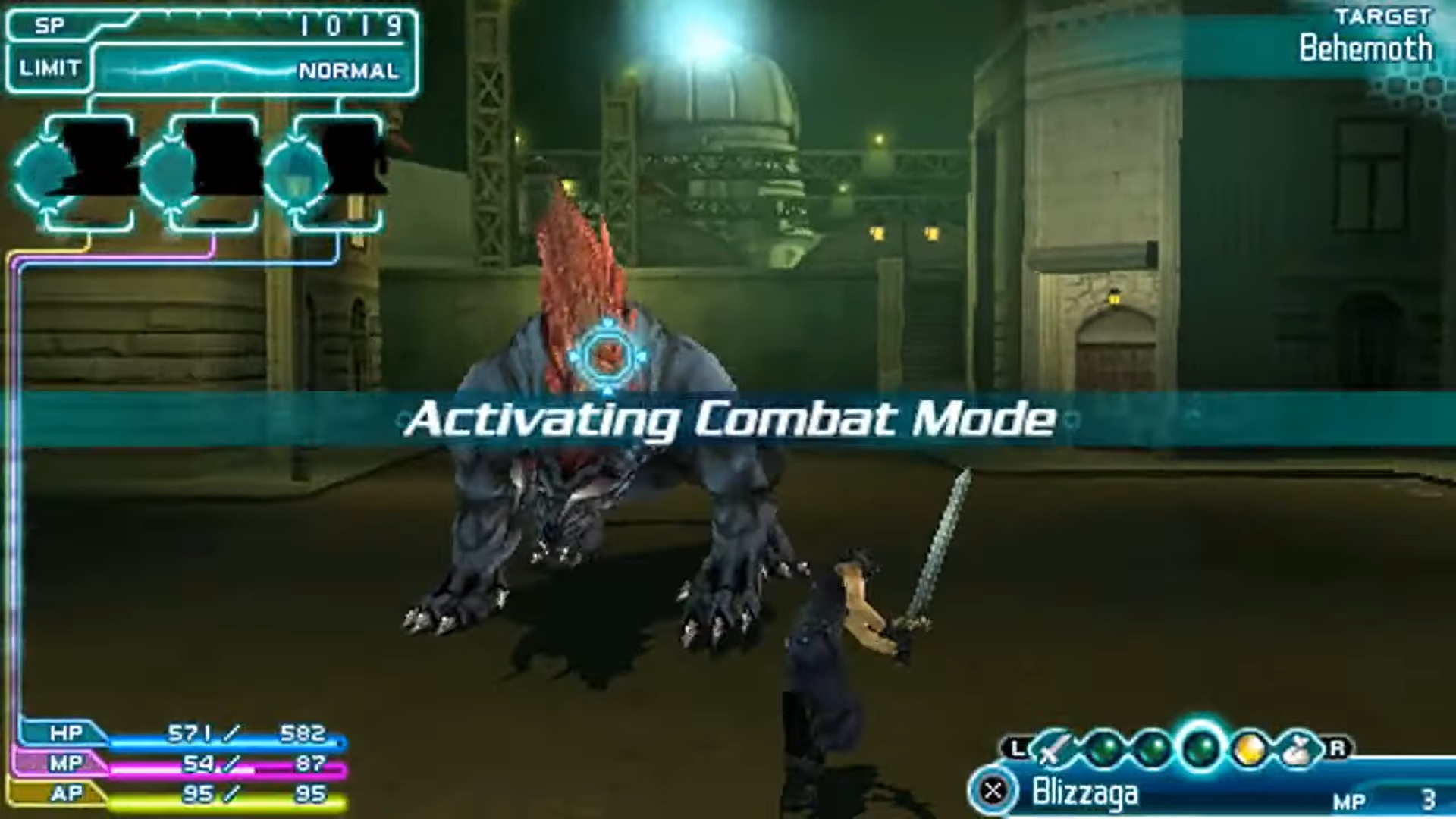
Real-time combat is fluid and fun - when not disrupted by gimmicks.

GAMEPLAY:

"Activating combat mode."

Crisis Core replaces the series' usual semi-turn based, ATB-gauge driven encounters with real-time combat. This is largely fluid and well-implemented. The triangle button blocks; the X button hits; the shoulder buttons are used to switch from swords to spells to items. Using items in combat can feel hectic and cumbersome, simply because you have to shoulder button through two menus to find and use the correct item, but it's overall engaging and surprisingly intuitive. Except that...

"Modulating Phase." (roulette wheel spins)

Except that, on top of the real time combat, Square Enix added the "Digital Mind Wave" (DMW). This is a roulette-like phase that, depending on its results, can result in special attacks and level ups both for skills and for Zack in general. It is the only way to gain levels in this game, so it is essential. It is also incredibly aggravating in its execution, particularly because...

"Modulating Phase." ---> 'Lucky Stars' "You can do it, Zack!" "Yeah, I'm on fire now!"

Particularly because the player is given no control over its activation. You'll find Zack powering up healing abilities while at full health, or using Summons that you'd prefer to save for a boss battle on no-challenge, low-level grunts. Not to mention...

"Modulating Phase." ---> No Match."

Not to mention that the DMW constantly interrupts the flow of combat... Meaning that if you don't get a match and nothing happens, the fraction of a second it takes for you to go back to dodging an enemy or casting a healing spell could all too easily result in a "Game Over." Crisis Core's main story is overall quite easy; as such, I'm pretty sure I died to DMW interrupts more often than anything else.

Finally...

"Modulating Phase."

Finally, I became extremely tired of the computerized voice intoning these phrases. Really, very, extremely tired.

"Conflict Resolved."

Fallen angels: Angeal, Sephiroth, and Genesis.

THOUGHTS:

Crisis Core, developed for Sony's Playstation Portable, stands as a showcase for the handheld's capabilities... as well as its limitations. The game offers dynamic (if flawed) combat, a terrific soundtrack, a variety of reasonably detailed environments, and cutscenes that are both fully voiced and skillfully animated.

The trade-off for all this is that the environments themselves are small. Very small. Most environments, whether interior or exterior, whether made for exploration or dungeon crawling, are similarly structured: A main path that loops around to maximize the limited space, with a few side paths leading off from it. In the city of Midgar, there will be three or four people per map whom you can talk to, and then you reach the border and a new, adjacent environment loads. In a dungeon, you fight three to four random encounters before reaching the border of the map and loading a new environment.

At least the story is good... for a while. The narrative spans years as it moves from the end of the war with Wutai to the hunt for Genesis. Through Zack's eyes, we get a sense of Shinra's degradation across this time that parallels Genesis's own degradation. Professionals who seem both affable and committed to their work are replaced by people who seem sinister or even disturbed. Scientific projects are shelved in favor of sinister experiments. By the time the fateful Nibelheim mission occurs, Zack wonders aloud what point there is to any of this, a statement of weariness that's a sharp counter to his early enthusiasm.

There's also a nifty thread involving the iconic Buster Sword, which emerges as a legacy in its own right. At the start of the game, the sword belongs to Angeal, Zack's mentor. As the story progresses, Angeal passes the sword to Zack. At the same time, Zack meets Cloud and becomes, in effect, his mentor... and of course, we already know that the game will end with Zack passing the sword onto Cloud - passing the torch between prequel and main game. Save for an overinflated speech at the end, this is all generally well done.

It's just a shame about the third Act.

The poetry-spewing Genesis: Worst Final Fantasy villain?

As the action moves to Nibelheim, everything seems in place for a memorable closing. Genesis has been defeated; Shinra has degraded into an entity Zack either can't or doesn't want to recognize; and he's embarking with Sephiroth on the misson that was the key backstory to Final Fantasy VII. At this point, all the game has to do to end up a firm winner is just flesh out the Final Fantasy VII flashback into a detailed chain of events.

But it's here that it all goes wrong. After spending a bit of time in the Nibelheim outskirts fighting enemies and completing side quests, you reach those key events... And then skip right over them, seeing basically only what was previously portrayed in flashback. Except with Genesis returning for no good reason except to make sure that Sephiroth is no longer even the focus of his own breakdown.

This is followed by an entirely unnecessary Fourth Act in which Zack (once again) tracks down Genesis, to a final dungeon that turns into an extended Easter Egg hunt. No, really: To proceed, you need to find all of the chests holding stones needed to unlock a door, while pausing to read synopses of the Acts of Loveless from headstones. When you finally reach Genesis, he first spouts more Bad Poetry at us... and then reveals that his sub-Vogon Poetry is also his deadliest attack.  The final fight is the series' most ludicrously easy Final Boss Battle since Mystic Quest, basically just requiring whaling on him and healing up whenever Zack's health gets low.

It ends with a brief epilogue leading directly into Final Fantasy VII. By this point, however, my previous engagement with the story was gone. I simply couldn't make myself care as the last cutscene played out. There's a post-credits bit meant to recreate the opening of the main game in the context of what we've just played... but even this doesn't work, with Cloud's attitude in this scene a complete mismatch with his ambivalence at the start of Final Fantasy VII.

Feathers from a fallen angel.

OVERALL:

There is much to recommend in Crisis Core. Despite technical limitations resulting in small and repetitive maps, the first half is genuinely very good. Zack is a likeable hero, and the background portrayal of Shinra's decline creates an effective parallel with the main plot.

I would rate this game much higher had the final Act not so thoroughly shredded the goodwill built up early on.  I'd still consider it worth tracking down, at least if you own a PSP. Though it was never made available digitally, as of this writing physical copies remain very affordable. It isn't a terribly long game (less than 30 hours, unless you try to play all the "Missions"), and there's enough that's good to offset the bad.

But with the final Act turning into a tedious and misjudged slog, I ended up with a negative final impression - even though, if pressed, I enjoyed more of it than I didn't.


Overall Rating: 5/10.

Alternate Version: Last Order - Final Fantasy VII (anime)

Followed by: Final Fantasy VII
Followed by: Final Fantasy VII Remake

Previous Main Series Game: Final Fantasy XII (not yet reviewed)
Next Main Series Game: Final Fantasy XIII (not yet reviewed)

Previous Release: Final Fantasy Crystal Chronicles - Ring of Fates (not yet reviewed)
Next Release: Final Fantasy Tactics A2: Grimoire of the Rift (not yet reviewed)

Review Index

To receive new review updates, follow me:

On BlueSky:

On Threads:

Tuesday, July 14, 2020

Final Fantasy IV: The After Years.

Original Release: WiiWare, 2008. Version Reviewed: PSP Complete Collection, 2011.


THE PLOT:

A second moon has appeared in the sky, and monster attacks have suddenly increased all over the planet. King Cecil marshals his troops to defend Baron Castle.

When Cecil's son, Ceodore, returns from training with the Red Wings, all initially seems well. The town is at peace. Soldiers are barring entry to the castle - but surely that's just a security precaution. Until he and a mysterious Hooded Man (whose identity is instantly guessable, by the way) sneak into the grounds and receive an audience with Cecil, who is behaving extremely strangely. Ceodore flees the castle at the Hooded Man's urging, and it isn't long before they are being pursued.

Meanwhile, Cecil's old companions investigate the reappearance of the moon from their own kingdoms. As Baron's Red Wings attack, once again seeking to gather the crystals, the old friends gradually gather together. Will they be in time to rescue Cecil from his apparent possession? What is the purpose of the crystals? And who is the nameless, unspeakably powerful little girl they keep encountering?


CHARACTERS:

Final Fantasy IV: The After Years is presented episodically, with each main character receiving a spotlight "episode" that takes 2 - 3 hours to play. As a result, some characters who weren't very interesting in Final Fantasy IV get stronger material here. Palom and Porom were amusing but two-dimensional in the original; both come across much better here, with Palom's personality shining particularly strongly in both of their episodes. Edward is more likable and proactive than in the original game. Edge is still irritating... but his episode ends up being arguably the game's best, as it effectively stitches the different perspectives together to strong effect.

Kain and Rydia, who were among the strongest characters of Final Fantasy IV are... again among the strongest characters, with the story often putting them at the forefront. The new characters, however, are a mixed lot. Ceodore barely has a personality, with it seeming that we're meant to care about him simply because he's Cecil's son. Rydia's friend, the dwarf princess Luca, is similarly bland. However, Palom's student, Leonora, emerges as an enjoyable foil for the arrogant mage, while Edge's students all emerge as more likable characters than Edge himself.

Who is the Mysterious Girl?

GAMEPLAY:

The game heavily reuses the assets of Final Fantasy IV, so it's little surprise that the gameplay is near-identical. The only major exceptions are some curveballs thrown into the combat. The effectiveness of physical and magical abilities are now linked to phases of the moon. In one phase, attacks are cut in half while spells are more effective; the reverse is true in another phase. In theory, this should force players to mix and match attack styles. In practice, it makes no real difference; your most effective attacks will remain so in almost all situations.  During an unfavorable lunar phase, it may just take an extra couple of turns to topple a baddie.

More significant is the ability of characters with close connections to perform "band attacks." Initially, there is minimal cause to use these; indeed, for the first half of the game, very few such attacks are even available. But later, when clearing challenge dungeons - and most particularly, when facing the myriad of bosses populating the final dungeon - success will hinge on effective use of these (hint: Kain + Ceodore, particularly once "Double Jump" becomes available. Even most bosses will be demolished within a couple turns).

Cecil turns against his former allies!

THOUGHTS:

Final Fantasy IV: The After Years is a divisive game. Some fans and reviewers praised it for its nostalgia value and for its storyline, which both follows up and expands upon Final Fantasy IV's lore and characters. Others savaged it for its wholesale reuse of the earlier game's assets, and for the many ways in which its plot retreads ground more effectively broken by its predecessor. Lampshading these similarities by having characters intone, "This is just like before" doesn't exactly negate the criticism.

The similarities don't particularly bother me, though, as the story moves sufficiently in its own direction to be interesting in its own right. I also enjoyed the episodic presentation. The alternating viewpoints are reasonably effective, particularly when events in one episode overlap with those in another, allowing the player to gradually piece the whole thing together like a giant jigsaw puzzle. Several episodes are also individually engaging: notably Palom's Tale, Edward's Tale, and Edge's Tale.

Unfortunately, there are a handful of misjudged elements. The game opens with arguably its two weakest "Tales." Ceodore's story does its job as an opener, introducing the second moon and the changes in Baron. However, Ceodore himself is such an unengaging protagonist that it's difficult to become invested. This is followed by Rydia's Tale, which is even worse. Despite Rydia herself being a well-drawn character, the story degenerates into a prolonged dungeon crawl, with little of interest occurring until the mini-story is almost over.

The remaining tales are increasingly more enjoyable.  As I played, my issues with the initial chapters gradually faded into the back of my mind. But The After Years saves the worst for last...

Yang and Edward go sailing, as their
episodes briefly overlap.

THE FINAL DUNGEON::

The characters travel to the heart of the villain's lair. A classic setup for a finale; and for its first third, this final trek does a good job of balancing character and story material against combat and exploration. The bosses that are encountered are often character-specific, encouraging you to mix and match party members to get the most interesting interactions out of these, and save points are sprinkled regularly throughout so that you aren't locked into making play sessions longer than you'd like.

So what's the problem? Bluntly - Length. The final dungeon is divided into three distinct areas, making up more than 40 floors total! That is an awful lot of dungeon crawling, and it's fair to say that it becomes tedious and even oppressive long before the end.

In the latter stages, having run out of Final Fantasy IV-related bosses, the developers try to appeal to general nostalgia by having Cecil, Ceodore, and company face off against bosses from other Final Fantasies. This leads to a tedious cycle: You crawl through the dungeon until you find a boss (represented by a crystal). The boss reveals itself as someone from a different, unrelated Final Fantasy game.  You fight and defeat the boss, at which point the nonplussed characters will make a few comments indicating how bizarre that was. Rinse and repeat... a whole lot of times.

Eventually, the party makes it through the interminable Depths (literally - the second, 29-floor area is called "The Depths"), and the plot finally reasserts itself. At this point, the game becomes interesting again, delivering reasonably satisfactory answers and an enjoyable final fight. But far too much patience is required to reach this point. Had I not been playing the game with this review in mind, I would likely have abandoned ship about midway through the dungeon and just watched the ending on YouTube.

Cut the final dungeon in half, and I would rate The After Years as a generally positive "6." But this last stretch is so tedious and downright irritating, it undercuts a lot of good material that came before. As a result, I can only rate this dead center of the scale. There's enough that's good that it's worth a run for Final Fantasy fans... but too much is poorly judged for it to be worthwhile for general gamers.


Overall Rating: 5/10.

Preceded by: Final Fantasy IV - Interlude

Previous Main Series Game: Final Fantasy IV
Next Main Series Game: Final Fantasy V

Previous Release: Final Fantasy Tactics A2 - Grimoire of the Rift (not yet reviewed)
Next Release: Final Fantasy Crystal Chronicles - My Life as a King (not yet reviewed)

Review Index

To receive new review updates, follow me:

On BlueSky:

On Threads:

Final Fantasy IV: Interlude.

Original Release: PSP, 2011. Version Reviewed: PSP Complete Collection, 2011.


THE PLOT:

It's been a year since Cecil and his friends saved the world. Many of the former companions are reuniting at Damcyan for a celebration of the successful reconstruction of the once-ruined castle. But the festivities are interrupted. Monsters have attacked a group of monks at a nearby mountain. More monsters are pouring out of the Sealed Cave. And the Tower of Babil, which a year previously was a villainous stronghold, is emitting an ominous glow...


CHARACTERS:

One of the pleasures of Final Fantasy IV: Interlude is that it allows players to catch up with the characters not long after the events of the main game. There are few surprises: Cecil and Rosa have gotten married; Yang remains devoted to his students even as he awaits a child; Palom and Porom are still getting up to mischief. But the characters remain likable and engaging, and much of the enjoyment of the game is in spending a little more time with them, before the generational shift of The After Years.


The plot confuses Cecil.  He is not alone.

GAMEPLAY:


Identical to Final Fantasy IV. A bit more deliberate grinding is required; the game is very short, and there's a distinct difficulty spike at the midpoint of it. If you tromp around the top level of the Sealed Cave a few times, darting out to save between battles, it doesn't take too long to level up enough to move forward... But it is an aggravation, just the same.


THOUGHTS:

Final Fantasy IV: Interlude is a trifle. It was created as value-added content for the PSP release of Final Fantasy IV: The Complete Collection - effectively acting as an enticement for people who already owned the base game and/or The After Years.

If you do already own the other, larger titles, then Interlude is absolutely not worth the purchase price. The entire campaign - grinding included - took me less than four hours to complete. I'm a bit compulsive about wanting to check every chamber of every map, so I'm fairly certain players with less completionist tendencies could polish it off in less than three hours. The story supposedly acts as a link between Final Fantasy IV and The After Years... but those links effectively amount to: (a) a certain character is pregnant, and has gone to the bad sitcom/soap opera school of refusing to tell anyone about it; (b) "There's more monsters!" ; and (c) a particularly vague introduction for a new villain. To call this expendable would be a compliment.

If you don't already have the other games, however, and opt for the PSP Collection (which I do recommend), then Interlude is a pleasant enough trifle. It's best looked at like one of those TV reunion movies made after a television series is canceled. No, it's not particularly meaningful or interesting, and the plot doesn't necessarily add up to anything... But it still has the feel of the original, the characters are still fun to spend time with, and it's short enough that there's no chance to become bored with it.

If it were ever sold individually, I would not recommend paying more than about $1.00 for Interlude. But taken strictly as a piece of value-added content, it's enjoyable. It's definitely not worth seeking out on its own, but neither is it worth skipping if you already have it.


Overall Rating: 4/10.

Preceded by: Final Fantasy IV
Sequel: Final Fantasy IV - The After Years

Previous Main Series Game: Final Fantasy IV
Next Main Series Game: Final Fantasy V

Previous Release: Dissidia 012 Final Fantasy (not yet reviewed)
Next Release: Final Fantasy Type-0 (not yet reviewed)

Review Index

To receive new review updates, follow me:

On BlueSky:

On Threads:

Monday, July 13, 2020

Final Fantasy IV.


Original Release: Super Nintendo, 1991. Version Reviewed: PSP Complete Collection, 2011.


THE PLOT:

The dark knight Cecil, leader of Baron's Red Wings, is troubled. He has just returned from his latest mission, an attack on the peaceful city of Mysidia. He followed his orders and seized the Mysidians' crystal for his king, but he cannot help but ask why such an order was given. In response, Baron's king strips him of his rank and sends him to deliver a ring to a nearby village. The mission is a ruse, the ring enchanted to release monsters that lay waste to the village, leaving one young girl as the only survivor.

Appalled by his role in this destruction, Cecil vows to stop his former liege. It's evident that the king plans to claim all the crystals from the assorted kingdoms, so Cecil and his allies attempt to defend those that remain. In the process, they discover that Baron's king is actually a demon in disguise - and that their true enemy has a plan that could mean the end of the world!


CHARACTERS:

As can likely be gathered from the plot description, characterization is much stronger in this game than in previous entries. Cecil is a particularly well-drawn character. As the game opens, he's a dutiful soldier following orders even when he doesn't agree with them. There is no serious indication that the Cecil of the game's opening would have defied his king's orders had more attacks been demanded. It is only after he is deliberately deceived and betrayed that he finally rebels against Baron's leadership.

Of the supporting characters, the strongest impression is made by Kain, Cecil's friend and fellow soldier. Kain feels like Cecil's equal and opposite in many ways. Like Cecil, he is portrayed as dutiful but decent, and early on voices support for turning against Baron, disgusted at seeing his troops used for evil ends. He is later brainwashed by the villains, with it strongly hinted (practically stated outright) that envy over Cecil's relationship with the white mage Rosa made him vulnerable to temptation. Kain's character moments end up providing the most memorable dramatic points in the game - in my opinion, he easily eclipses Cecil as the most interesting character.

Other roles are more two-dimensional, from warrior monk Yang to indestructible coot/inventor Cid to a pair of bickering twin child mages. Still, even if these characters lack much depth, they do have distinct personalities. No one is reduced to just being a name filling a role in the plot.


The Red Wings of Baron


GAMEPLAY:

Final Fantasy IV puts a few spins on the strictly turn-based combat of earlier entries. The most obvious of these changes is the way in which characters take turns. An "ATB gauge" fills up, determining when each party member will get to act. Some characters' gauges fill faster than others, and some actions (i. e., casting spells) take additional time to execute - and enemies can attack during that gap. This adds an additional layer to battle strategy, as finding ways to move those gauges faster against tough enemies (such as through "haste" spells and items) can turn the tide at least as much as upgrading weapons and armor can.

In addition to the gauge, there are different ways in which an encounter can take place. The default encounter will proceed based purely on whose gauge fills up fastest. However, you can also get a "pre-emptive strike," in which your characters start with a full gauge, allowing you to attack enemies before they can react. You can also either be attacked from behind or ambushed - either of which gives the enemy the first strike. The results can at times be frustrating - but it unquestionably adds more immediacy to the combat.

(The version I played - the PSP Complete Collection - allows for "auto battles," which can help reduce the tedium of frequent random encounters against weak enemies... Just be sure to turn the auto battle option off if you end up with a strong enemy!)

A mid-game boss battle.

THOUGHTS:


It's difficult to overstate the significance of Final Fantasy IV. I mentioned in my review of Final Fantasy II how that game had pushed forward a degree of narrative complexity far beyond that of the original game. IV takes what that game did for plot and applies it to the characters. Cecil and Kain are conflicted characters who, at the game's start, have rank, relationships, and backstory - some of which is directly spelled out, some of which (i. e., a love triangle with Rosa) is merely indicated. Roughly a fifth of the way through the game, Cecil finds himself in the very city he had just attacked when the story began - and the locals remember him and curse him for his actions. Even when he proves himself in a later quest, some of the inhabitants still bluntly say that they still can't forgive him. It's an added layer of sophistication in a series that can be seen advancing in various ways with each new entry.

There have been various reissues of Final Fantasy IV. I was torn between the PSP version and the Nintendo DS remake. The PSP won, after I looked up the opening minutes of each version on YouTube. I found the 2-dimensional sprites clean and visually appealing, whereas the 3-D character models in the DS version just looked ugly to my eyes. In the end, I think the preferred version is a matter of individual taste. I like well-drawn sprite animation; but the DS remake does feature roughly an hour of fully-voiced cutscenes, and reportedly offers more challenging combat, so many would likely prefer that variant.

Music has emerged as a consistent strength of this series, and Final Fantasy IV offers the richest score yet. From the militaristic theme for Baron's Red Wings, to the lyrical love theme, to the lively score that plays for twins Palom and Porom, the music sets atmosphere and character with extraordinary effectiveness.


NOT QUITE FULL MARKS...

This is an important game, and a very good one even today. But I did encounter some nitpicks. First, the version I played had an often ridiculous random encounter rate. In some maps, enemies would pop up every time I so much as took a step! Since most of these encounters qualified as little more than nuisances, it quickly became tiresome, even with "Auto Battle" activated. A minor annoyance, the kind of thing one simply accepts from JRPGs of a certain age, but it still bears mention.

The storytelling is good, particularly for an archive game, but there is one area in which it falls short of Final Fantasy II: Character deaths. The makers of this game seem to have an aversion to letting sympathetic characters die and stay dead! On at least three occasions, party members we had seen sacrifice themselves for the greater good end up popping up again, no worse for their ordeals. I found it diminished my investment in the dramatic scenes, knowing that there were unlikely to be lasting consequences.

Oh, and the final dungeon's too long. But it's not nearly as overlong as the final dungeon for Final Fantasy III was, and the last save point is located reasonably close (about 20 minutes' playtime) to the final boss, so those at least represent some noticeable improvements over the previous main series title.


OVERALL:

Those complaints do largely amount to nitpicks. Nearly thirty years after its initial release, Final Fantasy IV remains highly engrossing and enjoyable to play. Easily recommended.


Overall Rating: 9/10.

Sequel: Final Fantasy IV - Interlude

Previous Main Series Game: Final Fantasy III
Next Main Series Game: Final Fantasy V

Previous Release: Final Fantasy Adventure
Next Release: Final Fantasy Legend III

Review Index

To receive new review updates, follow me:

On BlueSky:

On Threads: